Rust Cheats Explained Through a Private Cheat Showcase
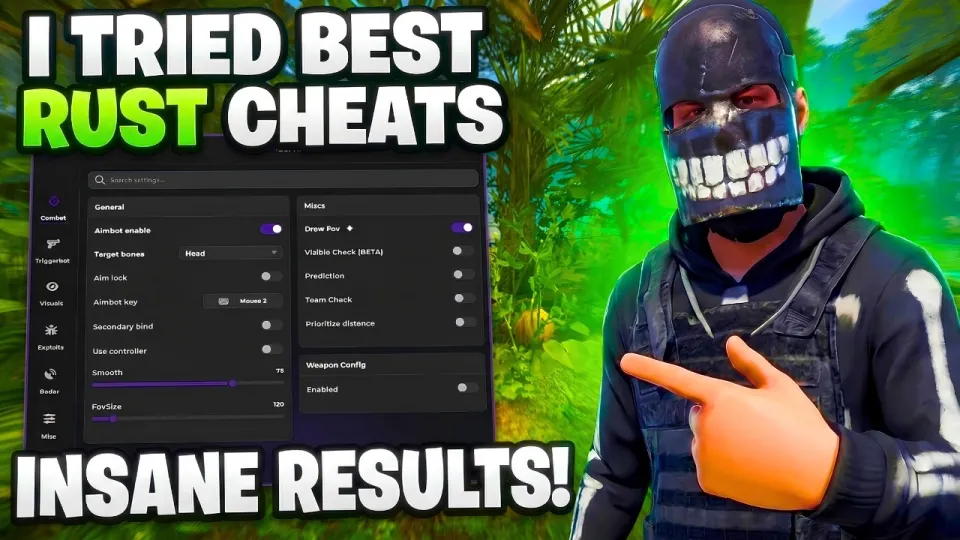
· based on the channel yqzkqrv
Key takeaways
- The showcase covers the ZALIANT Private Rust Cheat, sold through zaliantservices.com.
- The video breaks into four chapters: menu showcase, features overview, gameplay, and final review.
- The cheat is presented as a private (invite-style) product rather than a public mass-market build.
- Core modules shown are ESP/wallhack, aimbot, and a configurable cheat menu.
- Rust runs on Easy Anti-Cheat, so any external software carries a detection risk.
Rust cheats are third-party software overlays that add information or automation to Rust — typically ESP (player, loot and structure outlines through walls), aimbot assistance, and a configurable menu for tuning both. The most recent example is a private build showcased by the channel yqzkqrv, which walks through the ZALIANT Private Rust Cheat menu, its feature list and in-game footage; the product page is available at ZALIANT's private Rust cheat listing.
What the ZALIANT private Rust cheat showcase covers
The video is short and structured: an intro with the menu on screen, a features overview, roughly forty seconds of gameplay, and a closing review. That structure is typical of cheat showcases, and it tells you what to look at when evaluating any product of this kind.
- Menu showcase — the interface, tab layout and how settings are grouped.
- Features overview — the list of modules the build ships with.
- Gameplay — the cheat running on a live server, which is where you judge smoothness and visual noise.
- Final review — the creator's verdict and purchase pointer.
A private label matters here. Public cheats are sold to anyone with a card, which means thousands of users on the same build and a much shorter detection window. Private builds are distributed to a smaller buyer pool, usually through a Discord, and are updated more aggressively after Rust patches. That is the trade-off the showcase is selling: fewer users, higher price, theoretically longer lifespan.
Core modules: ESP, aimbot and the cheat menu
ESP, or wallhack, is the module most Rust cheaters rely on because Rust's gameplay rewards information — knowing who is inside a monument, where a stash sits, or whether a counter-raid is coming. A typical ESP layer draws boxes or skeletons for players, highlights loot containers and dropped bags, and can outline building pieces and deployables. Distance readouts and player name/team tags are standard toggles.
Aimbot in Rust is harder than in a pure shooter because combat mixes hitscan guns, projectile weapons like bows and crossbows, and melee. Good builds separate settings per weapon class: field-of-view limits, smoothness values, target bone selection (head, chest, nearest), and a visible-only check so the aim assist does not snap to players behind cover and instantly expose the user. Humanization settings — random smoothing, delay before the first shot — exist specifically to make footage look less mechanical.
Miscellaneous modules usually round out the menu: no recoil or reduced sway, instant hit registration tweaks, bright night or full-bright, silent footsteps, and fast loot or auto-deposit helpers. The menu itself is the part the showcase spends the most time on, and for good reason: a cluttered overlay with too many always-on elements is one of the easiest ways to get clipped and reported by other players watching your footage.
How Rust cheat pricing and access usually work
Private Rust cheats are almost never a one-time purchase. The common model is a recurring license — monthly, quarterly or lifetime — with the lifetime tier priced well above a full-price game. Access is gated: you buy through a store page, then get a role in the vendor's Discord where builds, loaders and update notes are posted.
The practical consequences of that model:
- Updates are the product. Rust patches weekly on Thursdays, and Easy Anti-Cheat signatures change with them. A vendor that does not push a rebuild within hours of a patch is a vendor whose users are exposed.
- Support quality is the refund policy. Most stores explicitly do not refund bans, so the Discord's responsiveness is the only real safety net.
- Account cost is part of the budget. A Rust account that gets game-banned is gone, and repeat bans on the same hardware can escalate. Serious users budget for a second account before they budget for the cheat.
If you are comparing options, price the license per month against the cost of replacing a banned account and the hours you would lose on a wipe. That number is usually less flattering than the sticker price.
Detection risk and why Rust bans hurt more than in other games
Rust runs on Easy Anti-Cheat, and Facepunch issues bans in waves rather than instantly, which creates a false sense of safety. A build that has run clean for three weeks can be swept in a single afternoon once a signature is added. Server-side statistics — impossible headshot ratios, pre-fire through walls, suspiciously consistent spray patterns — also feed manual and automated review on official servers.
The damage is asymmetric. Rust is a wipe-based game: a ban mid-wipe erases a base, a team's shared loot, and hours of farming, and it can drag teammates into the fallout if the account was tied to a group. Community and modded servers add their own layers, from admin spectating to anti-cheat plugins that flag overlay behavior independently of EAC.
That is the honest framing of any rust hacks showcase, including this one: the footage demonstrates that the software works in the moment, not that it will keep working. No vendor can promise undetected status, and any store that does should be treated as a red flag.
Where to find the product and community links
All links referenced in the showcase, copied exactly:
- Product page: https://www.zaliantservices.com/products/rustprivate
- Store front: https://www.zaliantservices.com
- Discord community: https://discord.gg/zaliant
The pattern is standard for this market — a storefront for checkout, a product page for feature lists and tier pricing, and a Discord for build distribution and support. Before buying anything, check the Discord's update cadence against the last Rust patch date; a channel that has been quiet since the previous wipe is the clearest warning sign available.
Final take on the private Rust cheat breakdown
The yqzkqrv showcase is a compact, menu-first look at the ZALIANT Private Rust Cheat: interface, feature set, a short gameplay segment and a verdict, all in about a minute. It is useful as a feature inventory — what ESP options exist, how aimbot settings are exposed, how the overlay is laid out — but it is marketing footage, so treat the gameplay as a demonstration of capability rather than proof of longevity against Easy Anti-Cheat. Weigh the recurring license cost against the price of a replacement account, and remember that Rust's wipe structure makes a ban far more expensive than the subscription. If you want to inspect the tiers and feature list yourself, start at the ZALIANT private Rust cheat product page.
Source: I Secretly Used Rust Cheat To Dominate Everyone In The Server...(INSANE) · Markdown version
Questions & answers
What features do Rust cheats usually include?
Most builds combine ESP/wallhack (player, loot and structure outlines with distance readouts), aimbot with per-weapon FOV and smoothing settings, and miscellaneous modules such as no recoil, full-bright and silent footsteps. Private builds typically add a configurable menu with saved profiles so settings can be switched between farming and PvP.
Are Rust cheats undetected?
No vendor can guarantee that. Rust uses Easy Anti-Cheat, which updates signatures regularly, and Facepunch bans in waves rather than immediately, so a build can appear clean for weeks before a sweep. Server-side stats and admin review on community servers add further risk beyond the anti-cheat itself.
How much do private Rust cheats cost?
Private cheats are sold as recurring licenses — monthly, quarterly or lifetime — with lifetime tiers priced well above the game itself. The real budget also includes a replacement Rust account, since bans are generally not refunded by cheat stores.
What happens if you get banned for cheating in Rust?
The account is game-banned and loses everything tied to it, including the current wipe's base and loot, and hardware or linked accounts can face escalation. Because Rust is wipe-based, a mid-wipe ban is far more costly than in a persistent-progression shooter.